Who he was
A County Durham man
Fred Dawson was born on 9 February 1918 in Barnard Castle, the old market town on the Tees in County Durham, the son of Fred Dawson and Mary (née Marshall). He married twice — his second wife was Edith, Linda's mother (his first wife was Audrey Constance Garrett). In the Second World War he served as a Serjeant in the Corps of Royal Engineers, and was decorated for gallantry. He died on 28 October 2006 in Darlington, aged 88, in the county where his life began.
He was known, and announced in the London Gazette, simply as Fred — the same name as his father; the army's medal recommendation form formalised it to “Frederick.”
Fred Dawson (“Frederick” on the MM form)
1882420
9 Feb 1918, Barnard Castle, Co. Durham
28 Oct 2006, Darlington
Fred Dawson & Mary Marshall
Edith Dawson (Linda's mother); first wife Audrey Constance Garrett
War Substantive Serjeant (Troop Serjeant)
The Military Medal (MM)
1939–45 Star · France & Germany Star · Defence Medal · War Medal
2 Valley Cottages, Bowes, near Barnard Castle
After the war Fred was demobbed — a normal Class A release — and by 1950 was living at Bowes in Teesdale. The family remembers that he worked as a chef, and that he may for a time have been recalled to the army; like every demobbed soldier he remained on the Reserve, liable to recall until he was 45. His trade and any post-war service will be confirmed from his service record. (Family recollection, pending the record.)
His unit
615 Field Squadron, Royal Engineers — Guards Armoured Division
Fred was a Troop Serjeant in 615 Field Squadron, Royal Engineers, one of the engineer units of the Guards Armoured Division. An armoured-division field squadron was the sappers who kept the tanks moving — clearing minefields, lifting demolition charges, bridging rivers and canals, filling craters and opening routes forward, very often under fire and ahead of the armour they served.
A field squadron was divided into troops; Fred was the senior NCO of a troop — the man who ran the sappers on the ground. His own citation records that his troop worked “in support of one of the battle groups of 32nd Guards Brigade” throughout the campaign, from Normandy into Germany. The division's engineers were 14th Field Squadron, 615th Field Squadron, 148th Field Park Squadron and 11th Bridging Troop.
The route
From Barnard Castle to a bridge in Germany
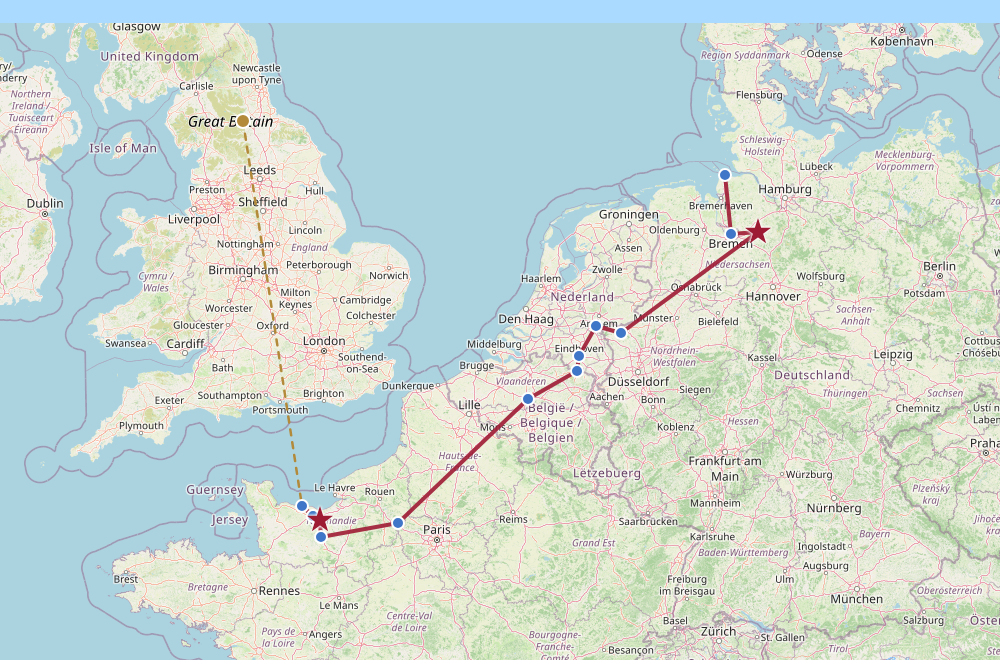
Interactive online — click any marker for the date, what happened, Fred's role, and document links.
Barnard Castle → Normandy → the advance to Rotenburg & Bremen. Explore it interactively in the online edition (QR code at the back).
His role, stage by stage
What Fred and 615 Field Squadron did at each point
As an armoured-division field squadron, their thread runs through the whole campaign: get the armour forward and keep it moving. Here is what that meant at each checkpoint.
A note on sources. The Rotenburg action is taken from Fred's own Military Medal citation, and the Market Garden / Nijmegen engineer work is documented for the Guards Armoured Division's Royal Engineers. The remaining entries describe the typical, well-attested role of an armoured-division field squadron at each place the division fought; his squadron's exact daily tasks will be confirmed from the unit war diary (WO 171/381 & WO 171/4110).
The timeline
Where Fred was, and when
The decoration
The Military Medal
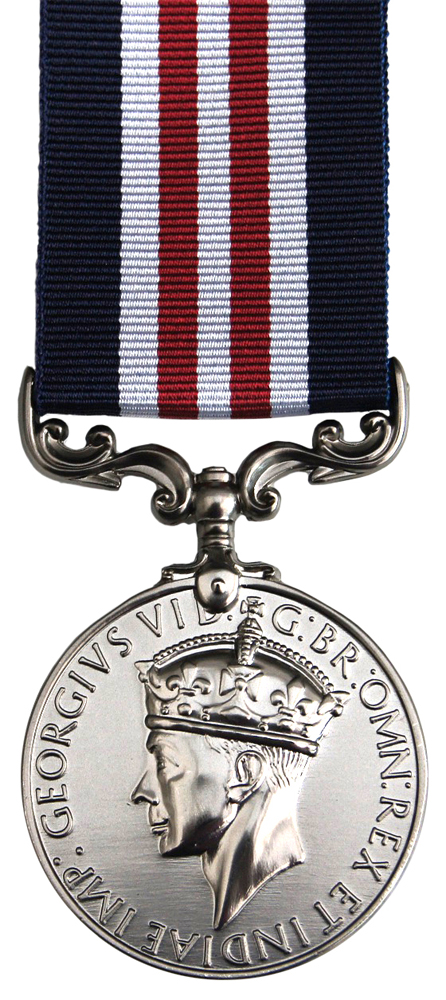
The Military Medal was the gallantry decoration for non-commissioned ranks — awarded for bravery in the field. Fred won his for an action at Rotenburg, Germany, on 28 April 1945, in the last fortnight of the war. The original recommendation survives in The National Archives (reference WO 373/56/166); his award was announced in the London Gazette on 24 January 1946.
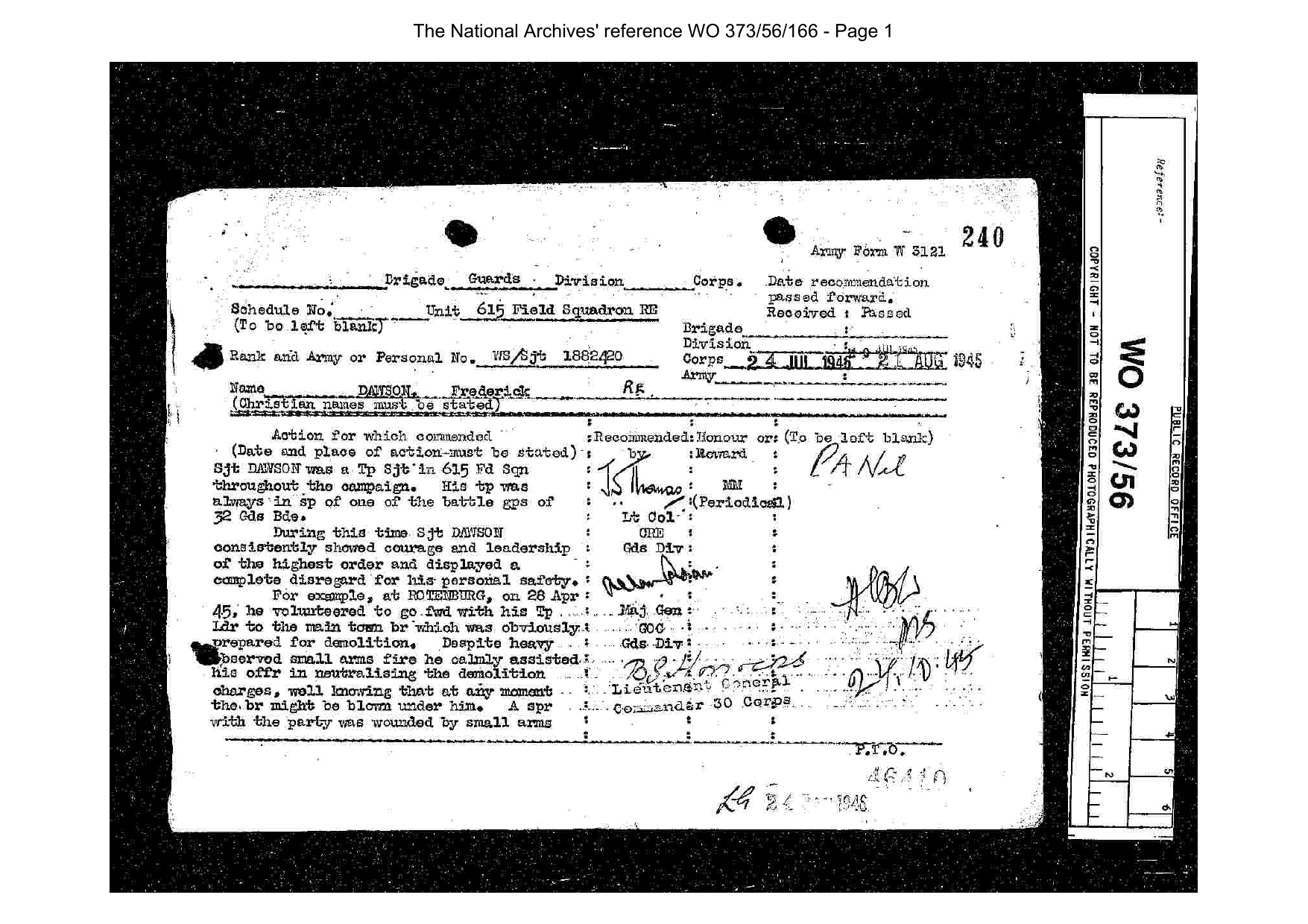
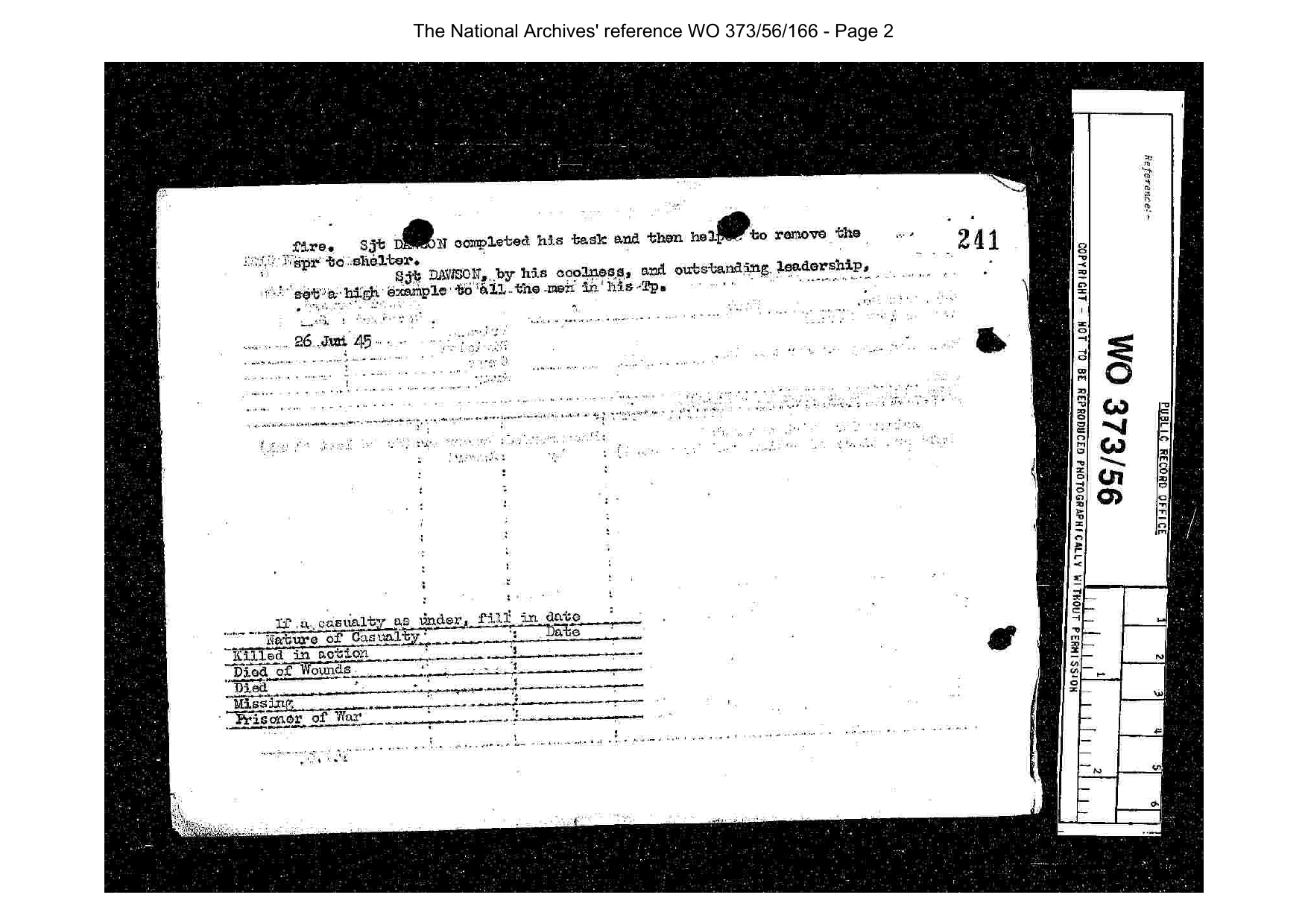
The original recommendation, Army Form W 3121 (The National Archives, WO 373/56/166, folios 240–241). Click to enlarge · open the PDF · catalogue record
What he did, in his commanding officer's words:
“Sjt Dawson was a Troop Sjt in 615 Fd Sqn throughout the campaign. His troop was always in support of one of the battle groups of 32 Gds Bde. During this time Sjt Dawson consistently showed courage and leadership of the highest order and displayed a complete disregard for his personal safety. For example, at Rotenburg, on 28 Apr 45, he volunteered to go forward with his Troop Leader to the main town bridge which was obviously prepared for demolition. Despite heavy observed small arms fire he calmly assisted his officer in neutralising the demolition charges, well knowing that at any moment the bridge might be blown under him. A sapper with the party was wounded by small arms fire. Sjt Dawson completed his task and then helped to remove the sapper to shelter. Sjt Dawson, by his coolness and outstanding leadership, set a high example to all the men in his Troop.”
In plain words: Fred and his troop officer went forward on foot, under heavy fire, to a bridge the Germans had wired to blow. He cut the demolition charges out by hand — knowing the whole bridge could go up beneath him — and when one of his sappers was shot, he finished the job and then went back for the wounded man. That is why he carried the letters MM after his name.
A last coincidence: six weeks later, on 9 June 1945, the Guards Armoured Division held its “Farewell to Armour” parade at Rotenburg airfield — the very town where Fred had won his medal — giving up its tanks for the last time with Field Marshal Montgomery taking the salute. Of all the places in Europe, the division said goodbye to its armour where Fred had made his bravest stand.
The pilgrimage
A campervan route in his footsteps
Normandy — the core (2–3 days). Where his war began and where he fought his Normandy battle. Distances are small: Arromanches to Caen ~30 km, Caen to the Goodwood villages ~10 km.
- Arromanches / Gold Beach — where he came ashore, ~28 June 1944. Mulberry harbour remains & museum; campervan aire in town.
- British Normandy Memorial, Ver-sur-Mer — overlooking Gold Beach. Camper parking €4.50/day; no overnight (use the Arromanches aire). visitor info
- Pegasus Bridge, Bénouville — the Orne & canal crossings in his sector; iconic and camper-friendly.
- Mémorial de Caen — the major museum; sets the scene for the Caen battles.
- Cagny & the Goodwood battlefield (east of Caen) — Cuverville, Démouville, Cagny, Émiéville, Vimont. ★ Fred's Normandy battle — the emotional heart of the Normandy leg.
- Falaise & Mémorial de Montormel — the close of the Normandy campaign.
Where to stay overnight (motorhome)
- Arromanches — aire in the town centre, two streets back from the sea, walk to the Mulberry-harbour museum (~€12/night). Harbour views from the Arromanches 360 site on the hill.
- Bayeux — Camping Municipal des Bords de l'Aure, a 10-minute walk into town; near the cathedral, the Tapestry and the largest Commonwealth war cemetery. An ideal two-night base for the Gold Beach area.
- Pegasus Bridge / Caen canal — aire at Colleville-Montgomery, or campsites at Ouistreham (Les Pommiers / Les Coutures) with a flat, canal-side cycle straight to Pegasus Bridge.
- Goodwood / Caen — base in or near Caen to reach the Goodwood villages east of the city (the British Normandy Memorial car park is daytime-only).
- Falaise — Aire Camping-Car Park de Falaise: 18 secure pitches at the foot of William the Conqueror's castle, water & electric (~€13/night) — a fine last Normandy night before Montormel.
Aires are first-come, first-served and can't be booked; arrive early in summer. Prices as at 2026 — re-check before travel.
Optional extension — following the Guards to where he won his medal. The Seine → Brussels (liberated 3 Sep 1944) → the Market Garden route (Joe's Bridge, Eindhoven, Nijmegen) → across the Rhine → Rotenburg (Wümme), the bridge where Fred won the Military Medal on 28 April 1945. A longer trip, but it ends exactly where his gallantry citation does. Belgium and the Netherlands have plentiful camperplaatsen, and Germany its Stellplätze, so overnighting near Brussels, Nijmegen and Rotenburg/Bremen is easy — I can detail specific ones for this leg.
And where it began — Dunkirk. The coast road from Normandy into Belgium runs straight past Dunkirk, where Fred's war started in 1940. It is worth pausing there — the 1940 memorial, the Mémorial du Souvenir in Bastion 32, and the mole and beaches — so the journey honours the whole arc of his service: lifted off these sands in defeat in 1940, and back across the Rhine to victory in 1945.
The tour
A camper pilgrimage, in his footsteps
A three-week route (Mon 7 – Sun 27 September 2026) at a proper camper pace — no drive day over about three hours, all overnight stops checked for the van's 7.3 m × 3.2 m. Sail overnight Portsmouth → Ouistreham (Brittany Ferries) — landing on his coast — with the Arnhem commemorations built in on 17, 18 & 20 September, and home on the shorter Rotterdam (Europoort) → Hull overnight ferry (P&O, ~11 hours at sea instead of 16; Hull is only ~85 miles from home).
- Normandy — Pegasus Bridge, Gold Beach & Arromanches (his landing), Bayeux, the Goodwood battlefield east of Caen, Falaise.
- The advance — the Seine, Brussels, Joe's Bridge, the Market Garden corridor to Nijmegen, the Rhine.
- Germany — Rotenburg (Wümme), the bridge where he won the Military Medal, and on to Bremen.
The records
Sources & citations
- Military Medal recommendation. The National Archives, Kew — WO 373/56/166, “Recommendations for Honours and Awards for Gallant and Distinguished Service (Army)”, Combatant Gallantry Awards, North West Europe 1944–45; folios 240–241. catalogue record · document (PDF) · page 1 · page 2
- Award announcement. The London Gazette, Supplement to issue 37442, p.642, 24 January 1946. view page · PDF
- Honours & awards index. Ancestry, index to WO 373 — Dawson, Frederick; WS/Sjt; 1882420; 615 Field Squadron RE; Military Medal; recommended 24 Jul 1945.
- Unit war diaries. The National Archives, Kew — WO 171/1660 (615 Field Squadron RE, 1944 — the Normandy-to-Nijmegen campaign) and WO 171/5751 (615 Field Squadron RE, 1945 — the diary covering the Rotenburg action of 28 April 1945); with WO 171/381 (HQ RE Guards Armoured Division, 1944, which records 615's Waal raft at Nijmegen) and WO 171/4110 (RE Guards Armoured Division, 1945). search the catalogue
- Service record — confirmed held at The National Archives, Kew (catalogue ref C19248003), currently closed pending an official record of death; it can be opened once a death certificate is supplied. Royal Engineers other-ranks records are in series WO 438 (not yet on Ancestry). request access
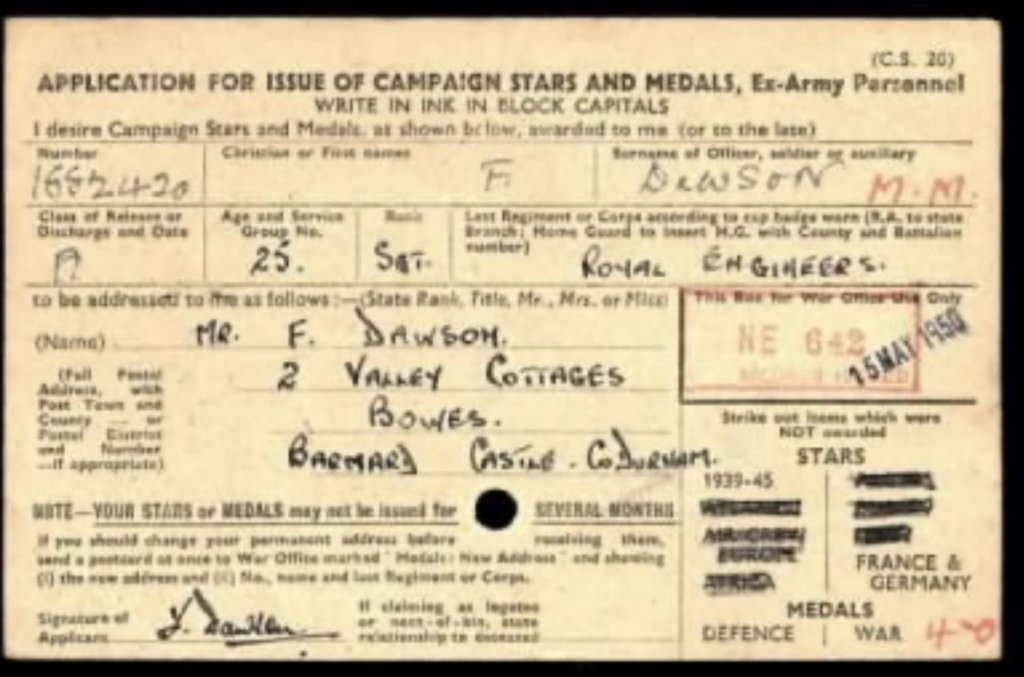
- Campaign medals — his own application. Army Form C.S. 20, “Application for Issue of Campaign Stars and Medals”, signed by Fred (War Office stamp 15 May 1950): No. 1882420, Sjt F. Dawson MM, Royal Engineers, of 2 Valley Cottages, Bowes; Class A release, group 25. It confirms his award of the 1939–45 Star, France & Germany Star, Defence Medal and War Medal. view the card
- Unit history & context. Wartime Memories Project — 615th Field Squadron RE; British Friends of Normandy — Guards Armoured Division; IWM — Guards Armoured at Goodwood; John Sliz, Bridging the Club Route: Guards Armoured Division's Engineers During Operation Market Garden (a unit-specific study that may name 615 Field Squadron).
Fred enlisted into the Corps of Royal Engineers in the closing months of 1939 — his army number, 1882420, falls just below that of a man known to have joined on 9 January 1940, placing his attestation in the autumn or early winter of that first wartime year. As a young sapper from Barnard Castle, he would almost certainly have been drawn into the Northumbrian engineers that recruited across County Durham and the Tyne–Tees country — most likely one of the Royal Engineer field companies of the 50th or 23rd (Northumbrian) Divisions, both of which crossed to France with the British Expeditionary Force and were caught in the headlong retreat of May 1940. The family's account that Fred was evacuated from Dunkirk fits this story exactly: as the perimeter closed at the end of May, it was the sappers who blew the last bridges and held the rearguards before being lifted from the beaches and the East Mole. The precise unit he served with in 1940 has not yet been pinned to the page — that proof waits in his service record at Kew — but the thread is unmistakable. The man who, five years later, would cut the demolition charges from a German bridge by hand under fire at Rotenburg first learned his trade as a Royal Engineer in the desperate spring of 1940, on the road back to Dunkirk.
The 1940 unit is presented here as likely, not yet proven; the Dunkirk evacuation rests on family memory pending his service record. This chapter will be filled in as the documents come in.